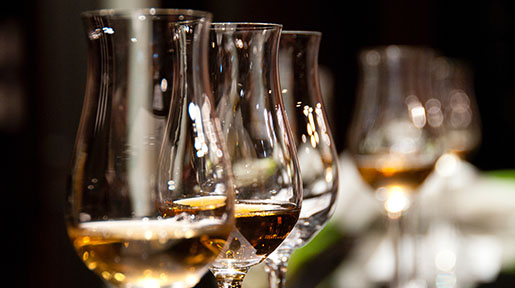
Johannisberg Riesling. Kloster Eberbach. The Geisenheim Research Institute. These famous names remind us that the Rheingau has always been at the center of Germany’s winemaking tradition.
The Rheingau is small in size, but looms large in German wine history. Here, at Kloster Eberbach, Cistercian monks began making wine in the 12th century. The Rheingau’s Johannisberg (Saint John’s Mountain) lent its name to riesling, Germany’s most famous wine. Here, too, spätlese was born in 1775. The Geisenheim Research Institute, sometimes translated as the Geisenheim Wine Institute, developed some of Germany’s most famous varietals, including Müller-Thurgau, named for the professor who created it.
Thousands of tourists visit the Rheingau each year. They come for the wine, of course, but they also visit to walk or bicycle along the Rhine River, to enjoy music festivals and to see the Rheingau’s many abbeys, castles and villages. Visitors and locals alike enjoy the Rheingau’s agreeable weather and panoramic views.
The region’s mild winters and warm summers help local winemakers create some of Germany’s finest rieslings. About 78% of the Rheingau’s vineyards are planted with riesling grapes. Nearly 13% are planted with spätburgunder (pinot noir), Germany’s most important red wine grape. The Rheingau, although small, has a wide variety of soil types. The nearby Taunus Hills help protect the area from harsh weather.
Hillsides are important in the Rheingau. Most vineyards in this region are located on hills, either steep, riverside slopes or gentle, rolling grades. In centuries past, monks and nuns built their monasteries and abbeys on hills; later, local rulers erected castles above the valleys to protect their lands. The monks planted wine grapes on their properties and nearby landowners followed suit.
Today, you can explore the Rheingau by car, train, bicycle, boat or on foot. The Rheingauer Riesling Route offers over 74 miles of roads that wind through the wine region. Cyclists can follow the Rheingauer Riesling Bike Trail (“Radwanderweg”). There’s also a hiking trail, the Rheingauer Riesling Pfad. In the Eltville area alone, you can hike 16 different trails (“wanderwege”) around the Johannisberg and see the famous riesling grapes up close.
Many visitors start their trip in Rüdesheim. This historic city is a gateway not only to the Rheingau but also to the Mittelrhein’s splendors. You can visit the famous statue of “Germania” at the Niederwald Monument (Niederwalddenkmal), which rises 105 feet above the river. The statue was built in 1871 and honors the victims of the Thirty Years’ War. Of course, there are plenty of wineries around Rüdesheim. Georg Breuer, for example, earned a score of 98 points from Wine Spectator for two of its Riesling Trockenbeerenauslese wines, Gold Cap Rheingau Rüdesheim Berg Schlossberg 2005 and Rheingau Rauenthal Nonnenberg 2005. Save up if you’d like to try these award-winners – they’ll set you back about $300 each.
If you’re interested in wine history, don’t miss Eltville, which is home to the famed Kloster Eberbach winery. Another historic Eltville winery, Langwerth von Simmern, scored 98 points from Wine Spectator for its Riesling Beerenauslese Rheingau Hattenheimer Nussbrunnen 2005. (Yes, it’s another expensive dessert wine, running about $300 for 375 ml.) Langwerth von Simmern has been making wine for an amazing 544 years.
Wiesbaden is the Rheingau’s largest city. The Romans built fortifications here, and Charlemagne’s biographer mentioned the city – he called it “Wisibada” – in 829 A.D. The city’s Kurhaus, built in 1907, is one of Europe’s most historic conference centers and is well worth a visit. The Kurhaus boasts an elegant casino, several restaurants and even a bowling green. Check the conference schedule before you visit; you may have a hard time finding a hotel room in Wiesbaden if a convention is in town.
Hochheim gave its name to German wine, at least in England. In 1850, Queen Victoria visited this small winemaking town and enjoyed its wines so much that she added them to the royal wine list. Back home in England, the wine’s name was shortened to “Hock,” and wines from Hochheim became perennial favorites.
If you’re visiting during the summer months, consider attending a concert. The Rheingau Music Festival attracts both wine and music lovers each summer. Held from late June until the end of August, the festival includes classical music, Dixieland, children’s concerts and soloists, with performances at wineries and concert venues around the region.
Whether you visit to sample the fruit of the vine, relax along the river or hike the Riesling Route, you’ll discover why the Rheingau has a special place in the hearts of those who’ve walked its paths and tasted some of Germany’s best wines.
In late-breaking German wine news, Wine Spectator gave Germany’s 2007 harvest a preliminary grade of A in their “Ultimate Buying Guide” issue (January 31 – February 29, 2008), confirming the results of last fall’s “fairy tale” weather.