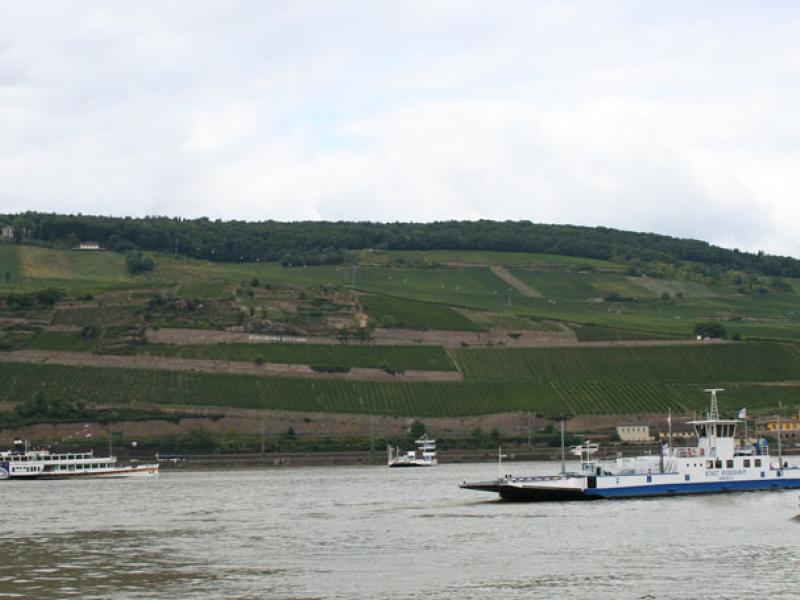
Germany’s second most well known wine region, behind the Mosel Valley, is certainly the Rheingau. Guided by the Rhine River, the steep slopes march down to the river itself like little lines of obedient cadets. Rudesheim is the most well know town within the region, the center of tourist activity where the train and the ferry land at its doorstep.
Within the Rheingau there are a multitude of unique vineyard sites and micro and mezzo climates, even though the area is one of the smallest wine producing regions in all of Germany. Three producers exemplify the longevity and new blood hitting the wine scene. Domdechant Werner, Leitz, and Schloss Reinhartshasuen all have unique stories and compelling wines.
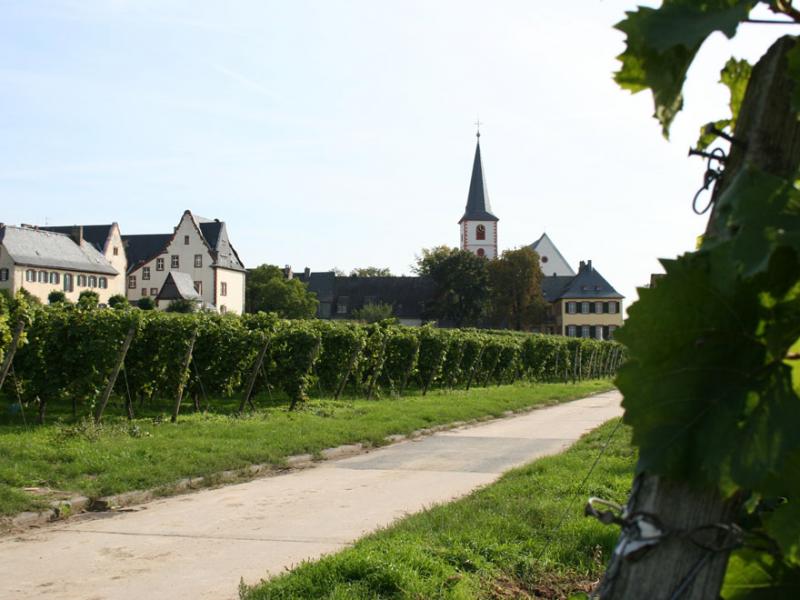
Domdechant Werner is lead by Dr. Fritz Werner Michel whose small estate sits above the Main River near where it joins with its big brother, the larger Rhine. From his estate, there are views of Meinz and nearby Wiesbaden. He welcomed me into his home (built in 1864) with enthusiasm and grace and eagerly showed me his property which has been in the family since 1780. Located in Hochheim, still in the Rheingau but southeast, he believes the area is a unique confluence of weather, soil and rivers. His property sits squarely at 50 degrees latitude and is the recipient of the colder Gulf Stream and warmer maritime influences. He feels the work of the vines is paramount. “I’m not so much a winemaker as a grape grower,” he says. Michel is steadfastly dedicated to the Riesling grape. “Just Riesling. No compromise,” he believes. “I’m very small, but I’m a global player,” he tells me.
Find Rheingau Wines and Producers Referenced in this Article:
- Rheingau Wine
- Domdechant Werner
- Leitz
- Schloss Reinhartshausen
Hochheim is well known for perhaps only one thing. This is where Thomas Jefferson visited in 1788 and brought vine cuttings back to America to plant in his own vineyard. In fact, Riesling has been shown in official documents to have been purchased in Hochheim as early as 1435. Michel exports approximately 75 percent of his wines. His dry style and sweet style Rieslings are softer and rounder than others in the Rheingau, more restrained but still having the acidity to balance out the sugars. There is a comfortableness to his wines, neither aggressive nor vague, but rather a sense of ease when drinking them. He’s rather pragmatic about the two distinct styles of his wines. “It’s not an issue of which is better, dry or sweet, it is two sides of the same coin.”
Though he produces single vineyard wines, it’s a not a widely appreciated philosophy in Germany, where documentation about single vineyards is inconsistent. The U.S. by contrast excels at promoting and marketing single vineyard wines and even specific clonal selections. “I cannot sell philosophy or dogma,” he responds, “I have to sell wine.” His preference is for older wines, a theme played out with most German winemakers. “Everything today is about the newest and freshest and youngest. This is a loss of culture,” he tells me. As proof of this, after we taste the 2007s, he opens a 2005 Riesling Spatlese, then a 2003 Auslese. But it was the 1998 Auslese that showed beautifully. A full ten years have passed and the wines dances across the palette like an aged ballet dancer, hitting all the correct spots, graceful and sublime.
Located on the Rhine River itself, Schloss Reinhartshausen commands impressive views to the river and surrounding vineyards. Walter Bibo is the managing director of the 45,000 case estate that also includes a five star hotel, restaurant, meeting rooms, a rustic bistro, historic wine caves (parts built in the 14th century) and of course, wine. Though German wines are becoming more prized in recent years, “in the late 1800s, German wines were more highly valuable than Bordeaux,” he says. Whereas the French wines currently garner high prices, Reinhartshausen is racking up a string of impressive credentials from the international wine press. The other unique selling point is that they grow chardonnay on a small island, known as Mariannenaue, located in the middle of the river. They can also claim that 35 percent of their total acreage is “first growth.”
Unlike many other estates in Germany, Reinhartshausen also produces other varieties such as chardonnay, pinot blanc and weissburgunder (pinot noir), however a full 85 percent of the wine produced on the estate is Riesling. The Schloss (German for “castle” and the equivalent of a French Chateau) has a long and varied history dating back to 1337. Reinhartshausen feels more similar to Napa than most any other wineries in the area, what with the diversity of a five star hotel, restaurants, tours and an impressive courtyard and building which can host weddings and other events. Tours of their cellars, which are definitely worth a stop, are by appointment and the subterranean caves are dotted with old photographs of the original construction, bringing to life the history of the Schloss.
To contrast the older wine producers, Josef Leitz winery (pronounced “lights”) is pumping out wine with a decidedly new school mentality. Johannes Leitz’s Dragon Stone Riesling (so named due to fossils found on one of his vineyard sites) is shipped exclusively to the States. That’s 8,000 cases for a growing export market, even though other countries are beginning to clamor for his best-selling wine. Though Johannes cultivates property on the steep south-facing slopes above the Rhine River, he’s less interested in the long standing history and tradition of the area than other producers. Of course, Johannes can trace his family wine business to 1744, but during World War II the vineyards were, “bombed out and I basically started new,” he said. Therefore his cleverly named Eines Zwei Dry (a reference to the first three numbers in German and a play on the non-sweet focus on the wine) is also doing remarkably well.
He’s most proud of his many vineyards that he farms, and happy to discus the soil, rich quartz and sandy loam soils left over as sediment from the glacial lakes that dominated the area millions of years ago. He farms over 20 vineyards which sounds impressive, until he explains that one vineyard “is only seven rows,” set on a sloping larger vineyard site. Johannes whole cluster presses most of his wines and the result is easy, accessible dry and sweet Rieslings. In fact during my tasting with him some sweeter style Kabinets appeared to be less dry than I had suspected. “That’s the whole thing of winemaking,” he said. “Making a dry wine not taste dry and a sweet wine not taste sweet.” It’s worth seeking out his popular wines in the U.S. He makes 12 different dry Rieslings, perhaps even too much by his own admission. His enthusiasm however is clearly evident and he visits the U.S. several times each year to introduce newcomers to his wines.
When in the Rheingau, these three producers are well worth seeking out. Though they all have some distribution in the States, there’s no substitute for visiting them firsthand. The rich history of the region, the quality of the wines and a bike, or boat tour along the Rhine River will provide a comprehensive understanding of this wine growing area.