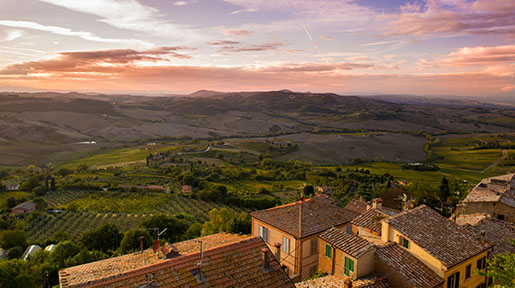
In the region of Campania, a wine is made that is a very nice every day wine that sells for a fair price and, in the hands of a few wineries, presents a very good buy. The really fun thing about this wine, however, is the name. I am speaking about Lacryma Christi del Vesuvio. Long before winemakers started putting cute animals on their labels or giving their wines fanciful names in order to market them to the general public, Lacryma Christi wines were flourishing.
The Rhone Report: About Rhone and Rhone-Style Wines and Winemakers is part of an ongoing series.
The French appellation contrôllée (or appellation d’origine contrôllée, AOC) system was born in the Rhone Valley (specifically, in Chateauneuf-du-Pape) in the early 20th century. The appellation system is intended to guarantee that the wine comes from the place (appellation) that is identified. It seeks to establish an expectation of a certain quality, and in doing so it sets forth specific requirements.
With one last column before Christmas and New Years, I would like to continue talking about the wonderful sparkling wines of Italy. This four part series started with the wines of Asti in the Piemonte, then we explored the Franciacorta’s of Lombardia, and the last column discussed the ubiquitous Proseccos of the Veneto. All of these will make tasty and affordable additions to your holiday festivities.
In this article, I want to explore a wine that may be one of the most misunderstood wines not only in Italy, but anywhere. That wine is Lambrusco.
It was pitch black as we made our way down the cliffside path.
I carried the flashlight and my friend carried the champagne flutes and a cold bottle of Roederer NV Brut. We found a bench halfway down the cliff and settled in to wait. Before long, we heard the cries from the hotel above: “Happy New Year!”
Another hotel launched fireworks across the bay, and the commotion awoke the frogs who chimed in. It was New Year’s Eve, 2000, and a perfect start to the Millennium on the Mendocino coast.
The Rhone Report: About Rhone and Rhone-Style Wines and Winemakers is part of an ongoing series.
As lovers of Rhone blends, we eagerly traveled to Paso Robles in the spring of 2005 to attend a “blending seminar” at the Tablas Creek Vineyard. We love both the white and red blends from the southern Rhone Valley, among them the wines of Chateauneuf-du-Pape, Cotes du Rhone, Gigondas and others. At home in California, we love the wines of the Tablas Creek Vineyard. So we were excited to attend this event and to learn more about blending these wines.
It’s a common Silicon Valley dream. The analytical person who catches the wine bug early in life and can’t wait for the day when they can focus their passion away from algorithms and code and towards winemaking. Rick Moshin is living that Silicon Valley dream. A former mathematician, Moshin entered the wine business gradually, working weekends at first, then learning the ropes working with some of the finest winemakers in Sonoma. He bought his first lot of vines in 1989 and in 2005 celebrated his first crush along with the launch of his 30 year old dream, Moshin Vineyards and Winery. IntoWine recently caught up with Rick to discuss his evolution from mathematician to winemaker and hear first hand what is an inspiring story of persistence and passion.
Everyone’s seen the labeling on wine bottles: “Contains Sulfites.” There is no shortage of opinions as to whether sulfur should be used at all in the vineyard or the winery. Much like anything, with opinions comes confusion. As a wine-industry professional, I would like to dispel some of the myths.
When it comes right down to it, there is always going to be some sulfur in wine. Sulfur is a natural byproduct of the fermentation process (yes, small amounts of sulfur can be found in bread too) and it is one of the most useful tools a winemaker has.
The English language has no accurate translation for the French word terroir. The closest thing we have is terrain, a word designed strictly to denote the way a land lays, a word for describing surfaces. Terrain says something, but far from everything, about terroir. At its closest, terrain is perhaps to terroir what a page is to a book, though terroir as a concept is admittedly more slippery.
When it comes to the topic of wines, particularly organic wines, separating myth from fact can be a daunting task. Much of the information available on organic wines is contradictory. While there is generally no argument that drinking wine made from organic grapes is better for you than drinking wine made from grapes laden with chemicals, there is quite a lot of controversy surrounding the topic of sulfites in organic wines.
This article is Part II of a two part series by Céline Guillou. Part I, "Green Wine: What Does "Green" Mean? Does it Taste Better?", can be viewed here.
Organic Wine
For many years, the simple mention of “organic wine” inspired a less than enthusiastic reaction from wine consumers, who generally viewed purveyors of organic wine as “tree-huggers”.