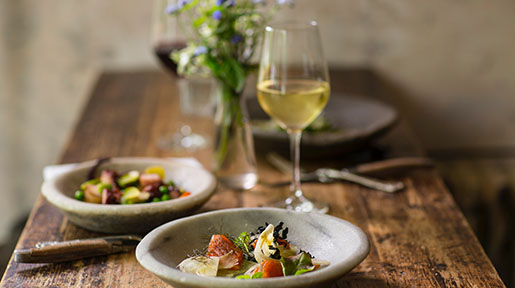
Let’s pretend for a moment that you are on vacation. The sun is shining. You are lounging on a veranda and the countryside around you seems to roll forever into the distance like a daydream. In this instance, when your thoughts fade to the warmth of the sun and simple foods and pleasures, there is no reason to confound your bliss with a wine that requires explanation.
What your bliss wants is a Rosé. There is no more perfect summer wine than Rosé.
Typically smooth and refreshing, “pink/blush” wines occupy a delicate status between crisp white wines and full-bodied red wines that requires a degree in linguistics to describe.
I say ‘delicate’ because Rosé often gets a bad rap for occupying that uncommon ground between red and white wines, and because there are so many variations between producers and regions that the “Rosé” family does not always deliver a sense of vintage or Appalachian like wines made from “The Big Seven” – Cabernet Sauvignon, Merlot, Syrah, Pinot Noir, Chardonnay, Riesling, Sauvignon Blanc.
Although Rosés are very easy to drink, they are not necessarily easy to make. Because they occupy a delicate place among wines that are increasingly specific displays of varietal character, they require an attention to detail that even the most finicky of winemakers tends to shy away from.
One common misconception about Rosé is that it is a blend of white and red wines crafted and blended together by the winemaker to satisfy a particular consumer profile. It is not.
What Rosé is however is an amalgam of two winemaking styles – In other words, the juice from red grapes is used to make a whitish wine.
Rosés are typically made from red grapes in one of two ways.
The first and lesser-used way of making Rosé is to crush and press red/black grapes so that a faint pigment (anthocyanin) is infused into or absorbed by the grape juice. The juice is then fermented much the same way it would be if a white wine were being made: at a cool temperature and with or without secondary malolactic fermentation. This style is typically used in Blanc de Noir (white from red) sparkling wines.
A second and the most prevalent way of producing Rosé is to de-stem red / black grapes and collect the juice and skins together in a tank. Over the course of several hours the juice absorbs the pigment (anthocyanin) from the grapes. When the juice has absorbed an appropriate amount of anthocyanin (between 60 / 120 milligrams/Liter) the juice is then drawn off from the tank and fermented in a white wine style, with or without secondary malolactic fermentation.
In the latter of the two methods, greater color is derived from longer contact between the grape skins and the juice (a maximum 12–24 hours). This greatly enhances the visual intensity and potential body of the resulting wine.
Grapes that have greater quantities of anthocyanin in their skins – Cabernet Sauvignon, Syrah, Grenache just to name a few – will typically have a lesser soaking time than say a Rosé from Pinot Noir which would usually need more time to fix color into its juice.
The winemaker’s choice to put Rosé through malolactic fermentation – a process that converts the green apple acidity (malic acid) to a creamier acidity (lactic acid) – is determined by the house style of the winery.
There are a great many differences in the methods wineries around the world use to vinify their Rosé wines and each region determines its own approach.
For instance, a “White Zinfandel” from California is made from only the Zinfandel grape, and a “Rosé de Loire” from France, can be made from one or more of the following grapes: Cabernet Franc, Malbec, Gamay, Groslot, Pinot Noir, Pineau d’Aunis.
White Zinfandel is typically fermented to retain a residual sweetness and was originally created as a response by United States winemakers in the late 1970’s to a surplus of Zinfandel grapes and a saturated Zinfandel market. They made “white wine” with the surplus of red grapes instead of making more red wine.
Rosés from the Loire Valley, in Northwest France, are fermented dry for the most part (an exception being Rosés from Anjou which are usually sweeter). Why large quantities of Rosé are made here is primarily the result of the cool climate, which does not produce robust red wines that could compete on the global market.
One region renowned for the quality of its Rosés is Provence in Southeastern France. The fame of these wines is perhaps due in large part to the hot summers and its proximity to the sea where millions of tourists spend their vacations each year.
Of course, there are certain enological advantages for a winemaker to produce a Rosé, none of which is more likely than an overripe red/black grape crop, which if fermented to dryness could produce a wine with very high alcohol. (The more sugar in the grape, the more alcohol it can produce.)
In this circumstance, a winemaker might bleed off a bit of the lightly pigmented juice from the macerated grapes and replace that juice with a water and acid solution that both lowers the potential alcohol of the juice and maintains its desired acidity.
The winemaker might then repeat the adjustment to the juice that’s been bled off from the macerating grapes and ferment that juice in the style of a white wine, while the juice and grapes inside the tank would be fermented in a typical red wine style over several days and weeks to extract its maximum color and intensity.
By utilizing the Rosé process, the winemaker ensures the potential quality of the wine produced from his red / black grape crop, and he creates a pink wine to sell to consumers.
It is more work, yes, but in the end it is about making the best wine possible – a wine that inspires the pleasures of life – and sometimes the perfect wine for the job and the veranda is a Rosé.