The Wine Cellar.....a place for wine to grow to maturity without distraction. Dusty bottles sleeping in orderly rows, breathing with imponderable slowness in a dark, moist, cool climate. Candle-lit treasures of ancient Bordeaux, golden brown Sauternes, mellowed California cabernet, and crusted Port await behind an iron gate. The wine cellar conjures up different images to different people. But whatever the image, it is simply a place to store wine. In this section we hope to give you practical advice on creating a cellar without taking away any of the romance.
Unlike most food and drink, wine can improve for years. This was not always so. Without the understanding that poor wine making, dirty storage containers, and exposure to air can cause a wine to quickly turn to vinegar, most of wine making history was operated on the assumption that the best wine was the newest wine. And so it was.
$1 Shipping Sale!
Check out The California Wine Club for hundreds of award-winning, limited production wines on sale now.
Save up to 70% off normal retail prices, plus every case ships for just $1.
Every wine is 100% guaranteed to be from a real-working winery, and a wine you will love – or your money back!
Visit www.cawineclub.com to learn more or call us at 1-800-777-4443 to take advantage of the $1 Shipping Sale going on this month only.
The Romans however, found that if a wine was placed in a tightly closed container it could improve with age without going bad. Some Roman wines were successfully kept as long as 100 years. Unfortunately, much of this insight disappeared along with the Empire.
From that time to this, wines have been aged with varying degrees of success. But it wasn't until the rediscovery of the cork – the Romans used it – and the improvement of the bottle, that aging wines went to a whole new level. Until the 1600's, bottles were fragile and quite expensive. The English were to change all this. By proclamation of King James I, all glass makers were to stop using wood to heat their furnaces so as to not deplete the forests. The glass makers turned to burning coal which allowed for a much hotter fire. Sir Kenelm Digby is credited as the inventor of the modern wine bottle. 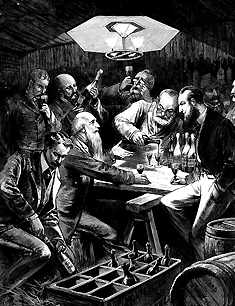
Of course, not all wines are meant to be aged. Most of the wines of the world are meant to be drunk young while they still possess their youth and freshness. Most of the wines that are destined to the cellar are red. Very few white wines need time to mature. For this reason, most white wines are purchased on an as needed basis. With that said, there's no doubt that all wine will benefit from even a few days rest after bringing it home.
There are many reasons for starting a cellar. At the top of the list is convenience. With a well stocked cellar, you can be assured of having the right wine at the right time. It is also fun to analyze a wine as it matures, to make note of the subtle changes in its taste and structure. By having the wine in your cellar, you can drink it after it has been allowed to reach its maturity and gain the maximum benefit from it.
Generally, wines are cheaper when purchased by the case or in bulk. Fine wine is relatively inexpensive and more readily available when it is young. Once it has reached it maturity it is at premium if it is available at all. Some people buy a case of wine as an investment and once the wine reaches maturity, they sell off half of it and then drink the other half for free. Whatever your motivation, a wine cellar is worth the effort.
Wine Enthusiast has a tremendous offering of wine related products.
Below are links to their current sale items:
- Refrigerated Wine Cabinets
- Stemware
- Wine Furniture (Cellars, Racks, etc)
Basic Storage Conditions
For a wine lover, a cellar is a necessity. Fine wines are worth paying extra for only if you can store and eventually serve them in good condition. Rarely are wines cellars part of the standard blueprint. So finding the appropriate place to store wine is an issue for almost everyone. A little ingenuity may be required. The principles behind storing wine are not complex, difficult to understand or necessarily difficult to achieve. And if you can't achieve them all, some of them are better than none.
Let's begin with the ideal. From here, you can then try to approach the ideal as close as you are able. You're looking to achieve balance and consistency.
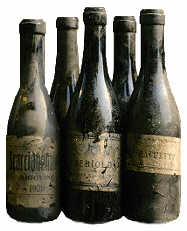
TEMPERATURE - Temperature is the most important factor and the factor that should be sought after above all others. The optimum temperature is 50 to 55°F (10-12°C). However, any constant temperature within 40-65°F (5-18°C) will do. More important than the actual temperature you will be able to achieve, is the degree and rapidity of fluctuation the wine is subjected to. A slow change of temperature of ten or so degrees between winter and summer is not a big problem. But this kind of fluctuation on a daily or weekly basis will cause damage to your wines and age them prematurely. You will notice damage of this nature from the sticky deposit that often forms around the capsule. In time, as the wine expands and contracts, it will damage the integrity of the cork. When this happens minute quantities of wine may make its way alongside the cork possibly even allowing oxygen to seep back in.
Wines kept at too high a temperature will age faster than wines kept at a cold temperature. Theoretically, wines kept at 68°F will age twice as fast as those kept at 50°F. At 55°F (12°C) wines will age so slowly – with ultimately greater complexity – that you will never have to worry about them. This is not to say the colder the better. Wine that is stored too cold can develop deposits or other suspensions in the wine. Finally, keep in mind that white wines are affected far more by temperature problems than red wines.
HUMIDITY - Moderate humidity is important so as to keep the corks in good resilient condition and thereby preventing them from shrinking. A relative humidity of 50-80% is the acceptable range, but about 70% is recommended. Excessive humidity will not harm the wine but will cause the labels and any other paper products – like cardboard boxes – you have in the cellar to rot. Insufficient humidity may cause the corks to dry out, lose their elasticity and thereby allow air to get into the bottle.
DARKNESS - Light will prematurely age a bottle of wine. Naturally, clear bottles are most susceptible to this problem, but ultraviolet light will penetrate even dark colored glass. Ultraviolet light may give a wine unpleasant aromas and ruin it. Extra care should be given to sparkling wines as they are more sensitive to light than other wines. It should be noted too, that incandescent or sodium vapor lights are better for a celler than fluorescent lighting.
CALM - Constant vibration from machinery or a nearby road disturbs a red wine's sediment and can be harmful to all wine. This is not commonly a problem in the average home as dangerous extremes are rare and obvious. It should be remembered that excessive sound creates vibrations that may be harmful as well. Wines should be stored in such a way that you don't have to move them around to get at a particular bottle. Once a wine is laid down, it should stay there until it is opened.
CLEANLINESS & VENTILATION - The space should be free from smells and debris. Extraneous smells can enter through the cork and contaminate the wine. Proper ventilation will help with this problem and keep the cellar from giving the wine a musty taste. Finally, debris that could be a home to insects that might infect the corks – untreated wood, food – should be removed. Never store fruits, vegetables, cheeses or any other food that is capable of fermenting.
ANGLE OF STORAGE - Table wine is stored horizontally so that the wine stays in contact with the cork. This keeps the cork moist thereby preventing air from entering the wine. Fortified wines other than port, are stored standing. If bottles are stored with the labels up, it will be easier to see the deposit of sediment that forms on the opposite side of the bottle when it comes time to open it.