The Rhone Report: About Rhone and Rhone-Style Wines and Winemakers is part of an ongoing series.
With summer vacation season just around the corner, some wine-interested travelers may want to learn about wine, food and sightseeing highlights in one of our favorite corners of the world – the southern Rhone Valley of France. Specifically, in this column we are focusing on the core of the Cotes du Rhone wine area in the northern part of the department of the Vaucluse, called Haut Vaucluse.
The Vaucluse
The Vaucluse includes Rhone River towns such as Avignon (home of the popes in the 14th century) and Orange (famous for its Roman ruins) and extends east to Mont Ventoux and south to the area called the Luberon, made famous by Peter Mayle in A Year in Provence and other books. It is roughly an hour north of Marseille and two hours south of Lyon. The Vaucluse is the northernmost part of Provence. In every respect, from the climate to the local foods to the architecture to the colorful markets, the Vaucluse is thoroughly and delightfully Provencal.
The northern part of the Vaucluse between the Rhone River and Mont Ventoux (at 6,263 feet, or 1,909 meters, it is a highly visible landmark for great distances) is the heart of the Cotes du Rhone (CdR) wine growing area and includes the town of Chateauneuf-du-Pape, famous for its AOC wines of the same name. Most wine lovers already know that the greatest wine of the southern Rhone is Chateauneuf-du-Pape. But not enough is known about some other very good, and less expensive, wines from nearby.
Discovering the lesser known areas
In this column, we are going to focus on wine, food and sights off the beaten path in the area just to the northeast of Chateauneuf-du-Pape.
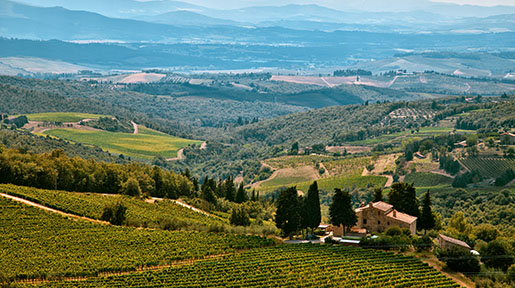
This is an area of great natural beauty and ancient stone towns, as well as outstanding wines and food. The towns and vineyards surround a dramatic set of ridges with jagged stone peaks known as the Dentelles de Montmirail (dentelle means “lace” in French). This isn’t a guide with detailed information on history, architecture, and entertainment. There are plenty of good travel guides for that. Nor is this intended to be an exhaustive survey of the wines of the area. Instead, we want to present some highlights to help first time visitors to the area, and to help those who know nearby areas such as Chateauneuf-du-Pape discover some of the lesser-known areas nearby. While our focus is on the wines, we offer some suggestions for good restaurants with good wine lists and we touch on the most scenic spots in this beautiful wine country.
Cotes du Rhone appellations and blended wines
This is the land of blended wines, in contrast to the wines of the northern Rhone (where the reds are nearly all Syrah). The southern Rhone reds are usually predominantly Grenache, with Syrah and Mourvedre in supporting roles and with Counoise, Carignan, Cinsault and other varieties often used in small proportions. The wines are typically lightly oaked, or not at all, letting the ripe fruit flavors shine. Depending on the vineyard site, the wines can range from lighter Cotes du Rhone to more substantial Cotes du Rhone Villages and AOC wines. The best CdR Villages wines carry the name of their village (e.g., Cairanne, Rasteau, Seguret, Sablet, etc.). In addition to the famous Chateauneuf-du-Pape appellation, the AOCs are Gigondas and Vacqueyras and the new (in 2005) AOCs of Beaumes-de-Venise and Vinsobres. Beaumes-de-Venise and Rasteau have separate appellations for sweet wines.
Beaumes-de-Venise
At the southern end of the Dentelles is the town of Beames-de-Venise, famous for its sweet, fortified Muscat aperitif or dessert wine (which has had AOC status since 1945 for this single wine).
The best, in our opinion, is produced by Domaine de Durban, founded in 1159. The property has an impressive panoramic view of the folds of the southern end of the Dentelles, Mont Ventoux, the town of Beaumes-de-Venise and across the plain to the Rhone River and beyond. In addition to the outstanding sweet Muscat wine, the Domaine also makes a refreshing rosé of Grenache and Syrah, as well as a couple of note-worthy reds. The AOC Beaumes-de-Venise red (one of France’s newest appellations, approved in 2005) is mostly Grenache with some Syrah and a little Mourvedre; because it is not oaked it is fresh and fruity, but with enough weight to make a serious wine. The Cuvee Prestige (Grenache with some Syrah and a little Mourvedre and Carignan) is unfiltered and spends a year in oak barrels.
Traveling north from the village of Beaumes-de-Venise on the east side of the Dentelles, the road climbs past the small village of Lafare to the tiny hamlet of Suzette. Along this route are wonderful views of the rocky and jagged Dentelles.
Just south of Suzette, a back road leads west toward the main spine of the Dentelles. A sign points to Chateau Redortier. This property is perched high (about 1,300 feet) and has dramatic views east to Mont Ventoux and south into the jagged ridges of the Dentelles. But the best reason for a visit is the excellent wines, none of which ever see any oak. Most of the Menthon-family vineyards are within the boundaries of the new Beaumes-de-Venise AOC, from which the Chateau offers several bottlings. The Cuvee Speciale from Grenache with some Syrah and a small amount of Counoise is delicious, and the distinctive blueberry flavor of the Counoise really shows despite the small proportion in the blend. A Prestige bottling is about 60% Syrah with about 40% Grenache; it is deep, rich, elegant and age-worthy. In our view, it is the very best wine from the Beaumes-de-Venise appellation. A small part of the Domaine’s vineyards are in the Gigondas appellation (see below), and Redortier makes an outstanding unfiltered Gigondas bottling from Grenache and Syrah. It is rich and tannic, with the fruit showing beautifully compared to most Gigondas wines that are typically oaked. To our taste, it is among the best wines of the Gigondas AOC.
Mont Ventoux
Continuing north along the road from Suzette are striking views south into the Dentelles ridges, then north and east toward Mont Ventoux.
The road drops into the town of Malaucene. This is the starting point for those wishing to climb (by auto, bicycle or foot) to the summit of Mont Ventoux. The views along the climb are spectacular. The summit is covered with white rock, so the summit appears to be snow-covered even in the middle of summer. From the summit the Alps are visible to the east. On a hot day, the higher elevations on Mont Ventoux are significantly cooler. This makes for some nice picnic spots on those hot days.
Vaison-la-Romaine
Taking the road northwest from Malaucene leads to the fascinating town of Vaison-la-Romaine, which makes a great place to lodge and explore the surrounding area. Vaison, as it is called for short, has ancient Roman ruins, an intact Roman bridge (the Pont Romaine) over the Ouveze River, a hilltop, medieval stone neighborhood (the Haute-Ville) capped by the ruins of a 12th century castle, a famous market (every Tuesday morning in the middle of town), good restaurants and stores to satisfy most shopping needs.
Among the restaurants worth trying is Le Bateleur, near the Pont Romain. Proprietor Jean Francois Sylvestre is a fan of the local wines and always offers some interesting choices. Another interesting choice for wine lovers is Le Bistrot d’O, a partnership between chef Raoul Reichrath of Le Grand Pre in nearby Roaix and and Yves Gras of Domaine Santa Duc in Gigondas, one of the very best wine producers in the area. For outstanding cheeses, one of France’s very best fromageries, Lou Canestéou, is in Vaison. Proprietor Josiane Déal carries an extraordinary selection of local cheeses as well as from throughout France. Not to be missed is the market, held every Tuesday morning since 1532. The fresh meats, fish, poultry and vegetable purveyors offer one of the very best selections in Provence. Prepared foods include paella, rotisserie chicken and quail, and pizza (try the chorizo pizza from the Pizza Roma truck).
Seguret
From Vaison, head southwest to the village of Seguret, perched on a hill and overlooking the plain to the west.
Known as one of the most beautiful village in France, Seguret is worth exploring. Park at the bottom of the hill and walk up through the village of ancient stone buildings. The best known restaurant in the village, La Table du Comtat, has a commanding view, but in our opinion the reputation exceeds the quality of the food, especially considering the price. We much prefer to eat at a small restaurant, Le Mesclun, with a view nearly as nice, a pleasant shaded terrace, friendly service, more inventive food and a nice selection of local wines.
From the bottom of the hill below the village, a small road leads directly east into the hills. Taking this road a short distance and then turning left at a T leads to Domaine de Mourchon. Seguret does not (yet) have AOC status; it is one of the Cotes du Rhone Villages entitled to use its own name (Cotes du Rhone Villages Seguret). Mourchon is the best producer in Seguret, although its first vintage was 1998 (the grapes from the vineyards, which average 35 years old, were previously sold to others). The vineyards are on hilly, very stony soil, which no doubt accounts for the wonderful minerality in the wines. The Loubie rosé is half Grenache, with Syrah and a little Carignan and Cinsault making up the remainder of the blend. It is crisp and delicious chilled. The Tradition red is a similar blend, with soft tannins and forward fruit in a well balanced wine. A Grand Reserve red is three-quarters Grenache with Syrah. Some of it is discreetly aged in oak barrels, contributing to a complex and rich wine. The modern winery facility is very welcoming to visitors.
Sablet
Traveling south from Seguret, the road quickly comes to the village of Sablet, set on a small hill overlooking the Dentelles and the surrounding plains.
Sablet is another Cotes du Rhone Village entitled to use its own name (Cotes du Rhone Village Sablet). To our taste, the premier wine producer is Jean-Marc Autran of Domaine Piaugier. Several outstanding bottlings are made. The Sablet blanc is a blend of Grenache Blanc, Viognier, Roussanne and Clairette. It is fermented in used barrels, which yields a wine that is both crisp from good acid and rich from the fruit. The Sablet rouge is mostly Grenache with some Syrah (which alone gets some aging in used oak). An unusual wine of 100% Counoise called Ténébi is from 40 year old Sablet vines and is bottled unfiltered after nearly two years in used oak. Another Piaugier Sablet rouge, Montmartel, is mostly Grenache with some Mourvedre; a small portion of it is aged in used oak barrels so as to preserve the intense fruit. Finally, Piaugier has a small amount of vines in neighboring Gigondas. From these vines winemaker Autran produces an outstanding Gigondas, with softer tannins than many from the appellation (probably due to a sensible restraint in the use of oak) and with forward fruit aromatics from the Grenache, Mourvedre and Syrah blend.
Just around the corner from Piaugier is Les Arbeilles, a new restaurant owned by Johannes and Marlies Sailers, who formerly owned the popular restaurant, L’Oustalet, in neighboring Gigondas. The Sailers always offer an interesting list of local wines and good food.
Gigondas
Just south of Sablet is the village of Gigondas, highly regarded for its AOC wines (AOC status dates to 1971).
We have several favorites, worthy competitors to the more expensive wines of Chateauneuf-du-Pape. We have already referenced the Gigondas reds from Chateau Redortier) and Domaine Piaugier. Domaine Santa Duc, cited above, makes an outstanding, rich, tannic Gigondas Cuvee Des Hautes Garrigues made for aging. Santa Duc is open only by appointment (but the proprietor, Yves Gras, is a partner in Le Bistrot d’O in Vaison la Romaine (see above), so some of the Santa Duc wines are available on the restaurant wine list). Domaine Brusset in nearby Cairanne (where they have a tasting room) produces a Gigondas bottling called Les Hauts de Montmirail (Grenache, Mourvedre, Syrah) from high on the slopes of the Dentelles east of the village. Domaine les Goubert offers the outstanding Cuvee Florence (Grenache and Syrah from 100+ year old vines with a tiny amount of Clairette). The Santa Duc, Brusset and Goubert bottlings cited have more oak than Redortier (no oak) or Piaugier (light oak), but the oak is much more integrated into the wine than is found in many Napa cabernets. Another favorite Gigondas is from Domaine de la Soumade in Rasteau (see below). The Soumade Gigondas emphasizes the fruit. All of these are well balanced wines, and together they illustrate the range of styles in Gigondas and the superb quality of its wines.
The small village of Gigondas, just off the highway, is worth a visit. It sits up high on a hill at the foot of the Dentelles with a panoramic view to the west. In the middle of the village near the Mairie (town hall) is a wine tasting room (Caveau des Vignerons) where samples of a large number of Gigondas wines from many producers are available to explore. Just outside of the village on a back road into the Dentelles is Les Florets, a restaurant well regarded by local folks and tourists alike. While we have found the food to be uneven in quality, the wine list is outstanding (a very broad range of Gigondas wines is featured) and the shady outside terrace is a wonderful place to eat on a warm evening.
Domaine les Goubert is located on the main road just south of town. In addition to its Gigondas red that we cited above, it offers a unique white wine that is worth a stop. The Viognier, made in very small quantities, is aged in oak for nearly a year. This is atypical for the region in two respects: (1) in the southern Rhone Viognier is not commonly bottled by itself because the climate is warmer than where the variety is normally grown (it is more common in the cooler northern Rhone Valley), and (2) oak is normally used vary sparingly for whites. The result is delicious, which surprises us because we prefer restraint in the use of oak. Goubert also makes excellent Beames de Venise rouge, Sablet rouge and Sablet blanc.
Vacqueyras
A few kilometers south of Gigondas is the village of Vacqueyras, which also has AOC status (since 1990).
We wish we could get more enthusiastic about this village and its wines. But the center of the town itself is a little drab, especially compared to its neighbors. More importantly, too many of the producers offer mediocre wine. Oxidized wine is all too common, and some of the wineries don’t bottle a master blend, but instead bottle over time, causing great variation from one bottle to another. Nevertheless, we do have a favorite: Domaine le Sang des Cailloux. The rouge (from Grenache, Syrah, a little Mourvedre and a tiny amount of Cinsault) is fresh and clean, with luscious fruit and oak nicely in balance. The domaine also offers Cuvee de Lopy from older vine Grenache and Syrah, and in certain excellent years a cuvee Oumage from very low yielding Grenache and Syrah.
Vacqueyras is almost back to Beaumes de Venise. If you have followed the sequence of visits above, you have almost circled the Dentelles de Montmirail. From Vacqueyras, a road leads northwest across the Ouveze River, through the village of Violes, and to the town of Cairanne. The village of Cairanne sits on small hill, making it visible from far across the surrounding vineyard areas.
Cairanne
Cairanne wines don’t have AOC status (yet).
It is another of the villages entitled to use its own name (Cotes du Rhone Villages Cairanne). In our view, it is overdue for AOC status, for the wines are excellent and there are many exemplary producers. Cairanne red wines are rich, powerful and spicy.
Perhaps our favorite Cairanne producer is Domaine de l’Oratoire St.-Martin. The Domaine offers three outstanding Cairanne rouge wines. The first is the Reserve des Seigneurs from Grenache with a generous amount of Mourvedre and a little Syrah. The second Cairanne rouge is the Cuvee Prestige from Grenache and Mourvedre. The third Cairanne rouge is the limited production Cuvee Haut Coustias, which is half Mourvedre and half Syrah, an unusual blend in the land of Grenache. These bottlings are all from old vines, over 50, 90 and 60 years, respectively. All are unfiltered. The Grenache based wines, Seigneurs and Prestige, are not oaked. The Haut Coustias spends about a year and a half in used oak barrels. The Domaine also makes a couple of excellent white wines, including a Cotes du Rhone Village Cairanne blanc that is a blend of Marsanne and Roussanne with a little Viognier and Muscat. Despite the heat in the vineyards, this white wine is crisp and refreshing as well as rich.
We also greatly admire the wines of Domaine Rabasse-Charavin, run by Corinne Couturier. Some of the bottlings now appear under her name. Her wines are concentrated and deep without seeming heavy. The Cairanne bottling is mostly Grenache with some Syrah and Cinsault. The prime cuvee, d’Estevenas, is from a small, low-yielding part of the vineyard. Rabasse-Charavin also makes outstanding CdR Village Rasteau (see below) from the neighboring village. Another of our favorite Cairanne producers is Domaine Brusset, whose Gigondas we have already praised. Brusset has a tasting room just south of Cairanne in the direction of Violes. The CdR Villages Cairanne les Travers cuvee is a Grenache based wine with Syrah, Mourvedre and a little Cinsault added. In very good vintages Brusset offers a CdR Villages Cairanne called Cuvee des Templiers, a blend of Grenache and Mourvedre from old vines; it is obviously the richer of the two. We also enjoy the Brusset CdR Villages Cairanne Rose, a blend of Grenache, Carignan and Cinsault with a little Syrah. Another outstanding Cairanne producer is Marcel Richaud, whose top bottling, CdR Villages Cairanne Cuvee L’Ebrescade, is an old vine, deep, rich blend of mostly Grenache with some Syrah, Mourvedre and Cinsault.
Rasteau
Rasteau is a small village east of Cairanne, in the direction of Sablet and Gigondas.
It is noted for its AOC Rasteau-Village Vin Doux Natural (VDN) red and white sweet, fortified port-like wines from (mostly) Grenache.
Rasteau also produces superlative Cotes du Rhone Villages Rasteau, not surprising given its location between Cairanne just to the west and Gigondas, Sablet and Seguret to the east. Our favorite in Rasteau, and one of our favorites in the whole Vaucluse, is Domaine de la Soumade, whose tasting room is located a short distance southwest from the intersection by the local wine cooperative. The tasting room itself is only about four years old, and has a large picture window looking east with a panoramic view of Gigondas and the Dentelles de Montmirail. The proprietor, Andre Romero, makes luscious, concentrated wines. His line-up of CdR Villages-Rasteau reds include a cuvee normale, a Cuvee Prestige, a Cuvee Confiance, and a Cuvee Fleur de Confiance. The Prestige bottling is from vines (over half Grenache with some Syrah and other varieties) nearly 50 years old, and the difference shows compared to the normal cuvee. Our favorite, the Confiance bottling, is from Grenache vines nearly 100 years old with some Syrah. The fruit is deep and rich, but despite the concentration it is a well balanced wine. The Fleur de Confiance cuvee has more oak, and isn’t to our taste, although fans of oaky wines should love it. We already noted that Soumade also makes an outstanding Gigondas. In addition, Romero makes classic VDN rouge and dore (white).
We already noted the CdR Villages-Rasteau grown and produced by Corinne Couturier of Domaine Rabasse-Charavin in neighboring Cairanne. Couturier’s Rasteau is a Grenache and Mourvedre blend, so it is different than Soumade’s. The Mourvedre component gives it a crisp quality compared to the rounder versions made without this variety, and the flavors are complex and nuanced.
The best local restaurant
Just up the road from Rasteau is another tiny village, Roaix.
This is the location of the best restaurant in the wine country we have been discussing. Le Grand Pre, run by chef Raoul Reichrath and his wife Flora, is a must stop. You may recall that Raoul is a partner in Le Bistrot d’O in Vaison la Romaine, a new venture. At Le Grand Pre the small terrace in the rear is peaceful and relaxing on a warm summer evening. The food is an elevated version of Provencal cooking. Flora has assembled an outstanding list of the local wines; just ask her advice about labels you don’t know and discover new gems.
The restaurant with the best list of Rhone wines
A final restaurant is a must visit for wine aficionados. It is the La Beaugraviere in Montdragon, a small town along the Rhone River about 25 minutes west of Cairanne and just south of Bollene. It is between the N-7 (the old main north-south route through the Rhone Valley) and the railroad near the north end of town. The property itself is a huge, rambling structure in need of some repairs. The dining room is restored to a pleasant condition. The terrace used for most summer dining is nicely shaded and comfortable. The food is entirely satisfactory but not great. However, the real reason to visit is the wine list. La Beaugraviere has one of the best, if not the very best, list of Rhone wines to be found anywhere. The list has an extensive selection of Chateauneuf-du-Papes, including numerous vintages of stars like Chateau Beaucastel and Chateau Rayas. It also includes many of the best Gigondas and other wines from the area we have been discussing. In addition to this selection of wines from the southern Rhone, the list has a great selection of the best wines from the northern Rhone, including Hermitage, Cornas and Cote Rotie.
Unique Terroirs
As you taste wines from different places within this area, you will find that the wines are slightly different.
That’s because the geology, the soil types, the elevation, the temperature, the exposure to the sun and all the other factors that contribute the unique flavors to wine change from vineyard to vineyard. These differences are noticeable even within the same village.
For example, in the Gigondas AOC, the high mountainous vineyards on the southeast side of the Dentelles de Montmirail (these vineyards get the early morning sun) have a very different exposure from the high vineyards on the west side (these catch the hot late afternoon sun), yet both these higher elevation areas are cooler than the remainder of the AOC. Both of those are different than the rocky vineyards lower down on the west side of the Dentelles near the village of Gigondas itself, which in turn are different than the stony, clay vineyards on the flatter areas to the west of the village on what is called the garrigue (named for the mix of aromatic Provencal herbs and shrubs such a lavender, rosemary and sage that grow on the undeveloped areas). Yet all are within the Gigondas AOC. We have cited superlative examples of Gigondas from each of these specific growing areas even within this single AOC. Similar variations occur within each of the specific areas we have been discussing. These nuances from vineyard to vineyard and village to village are clear demonstrations of what the French call terroir, the unique combination of environmental factors that shape the flavors of wine from each site.
The different blends of grape varieties also adds to the variety of wines to be found within this small area. While nearly all the reds are Grenache based, the addition of Mourvedre, for example, changes the character of the wine differently than the addition of Syrah. Some of the differences among blends are dictated by the terroir of each vineyard. Typically Syrah is planted in the cooler sites whereas Mourvedre likes more heat and won’t ripen in the cooler sites. Nevertheless, winemaker/grower preferences often account for the different blends from each vineyard more than the limitations of the terroir.