There are few people who have thought harder or more comprehensively about where the French wine industry has been and where it is heading than author Andrew Jefford. In his book, The New France, Jefford delves deep into seemingly every angle of importance regarding French wine. The reviews have been uniformly exceptional. The New York Times called it "the best book around on the contemporary French wine business" and Robert Parker labeled it "a brilliant effort". Andrew Jefford is an award winning author of nearly a dozen books on wine, spirits, and libations. IntoWine.com recently had the privilege of chatting with Andrew about his book, The New France, as well as his views on the French wine industry.
Your book has received much more critical acclaim than the typical wine guide book. In creating this guide, what did you do to differentiate it from the gaggle of wine guides available on book shelves?
First of all, I didn't really think of it as a wine guide. I wanted to write a book which people would want to read for the pleasure of reading, and which would convey, as vividly as I was able, my passion for France and its wines. What Roland Barthes called 'the pleasure of the text' doesn't often emerge in wine writing, yet that pleasure is an essential requirement if a text is to endure. Everything in the wine world changes annually, so any book which is no more than a guide has a built-in obsolescence. That said, The New France does of course also function as a guide, and those parts of the book are beginning to need revision now. But I hope at least half of the book will still be of interest to readers in twenty or thirty years.
The second difference is perhaps one of attitude. Small details for me can be as telling as facts and figures; descriptions of places and people can be as useful as tasting notes; and broader political and social issues have a bearing on wine culture, too. I wanted the book to be as all-embracing as possible.
As the book's title implies, the French wine industry is in process of redefining itself. Who, or perhaps what, are the catalysts of change in the new French wine industry?
Economics is, as always, the major catalyst. One-third of all the wine produced in France has no market, and should not exist, and everyone in the European Union is getting tired of subsidising it. Those wines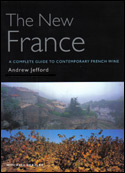
Competition from other wine cultures is another major catalyst. The market is a fierce one, and at the commodity wine level France has some major structural difficulties which make it hard to compete (specifically, lack of giant wine companies and brands). It is finding ways of overcoming these difficulties at present. This does not mean imitation; it means finding a French alternative.
There are individuals who are important for France (Michel Rolland is the name which most readily springs to mind) but wine production there is in the hands of so many individuals that I would say that the collective will and readiness to change and succeed is far more important than any individual. I believe that will and readiness is there.
The missing catalyst at present is the bureaucratic or political one. The administration and promotion of French wine badly needs a major shake-up so that France can communicate its strengths more effectively on the international stage. Put more simply, so that the non-French can begin to understand French wine, something most ordinary consumers find off-puttingly difficult. I see no sign yet that the changes are in hand to bring this about.
You devote an entire chapter to terroir. Anyone reading this knows the French soil and climate are ideal for grapes. What are some of the more nuanced advantages France has in terms of its terroir?
France lies between 43 and 50 degrees north -- the ideal northern-hemisphere latitude band not for viticulture per se (that would probably equate with Italy's 36 to 46) but for high-quality viticulture, which is mostly found towards the margins of the climatically possible.
France is a geologically young country, much of which was formed under the sea. This means that it has more than its fair share of limestone, which seems to produce wines of great finesse.
France's centre and south (where climatically most of the wine action has to happen) is dominated by three uplands -- the Pyrenees, the Massif Central and the Alps. The foothills of these provide a range of ideal slopes (which have advantages of aspect, exposure and drainage).
France has four major river systems, three of which also provide both slopes and former river-bed gravels, both of which make propitious vineyards.
That's really the story. It's got the right ingredients in the right place. The French genius (a slightly obsessive interest in the aesthetics of daily life, whether it be food or drink or clothes, art, literature, music or sex) has teased away at these raw ingredients for centuries, and not only found the most propitious terroirs but also found the vehicles in terms of grape varieties and winemaking methods to bring these to perfection.
In what ways are the decades (and sometimes centuries) old French wine laws inhibiting France as a wine producer?
Principally, in my opinion, in rendering French wine incomprehensible to too many consumers. I feel very strongly, though, that the solution is not to simplify (the complications are what is most precious about French wine culture) but to explain more effectively.
There is nothing wrong with wine laws per se, though we have to remember that mostly they were put in place 70 years ago when many wine producers were entirely uneducated and needed laws to help them produce better wine than they were doing at that point. But most French wine laws just codify the successful outcome of centuries of experiment, which is why most of France's top wine producers are entirely happy with them. I don't think Alain Vauthier of Ausone wants to plant Chardonnay; I don't think Aubert de Villaine of DRC wants to plant Merlot.
How are the french wine laws evolving to enable the "New France" to emerge?
Slowly. As I intimate above, I don't think French wine law as far as it affects AOC needs fundamental revision (and I am very opposed to the plan to create a two-tier AOC system, which will simply confuse an already confusing picture further). There is always a need for tweaks and modifications to individual AOCs, of course, and these tend to come too slowly.
I do think, by contrast, there should be total liberalisation of Vins de Pays laws, so that every region of winegrowing France also has a Vins de Pays alternative, and that Vins de Pays alternative is almost entirely liberal in terms of the varieties which could be used. Changing the rules to allow cross-regional blends is a good idea, though such blends should never aspire to AOC. And the rules surrounding Vin de Table should also be liberalised, so that if high-quality producers want to use that category they can, in full communicative freedom.
The book has in-depth chapters devoted to each of France's 14 wine regions with regional and historical overviews, profiles of winemakers, and descriptions of the land and the wine makers that make French wine what it is. Which angles didn't you explore that in hindsight you wish you could have included?
I just wish I had had twice as much time and twice as much space -- to have done a better and more inclusive job on the producers, to have codified the appellation information in 'The Adventure of the Land' more effectively, and to have spent more time polishing the introductions. Commissioning new, better and more numerous maps would also be a great advantage. But I think the overall scope was more or less right.
France as a wine producer is shaped and defined by centuries of custom. Much of this history adds to the charm and quality of French wine. Did you find any legacy issues -be they wine making techniques, industry standards, or attitudes- that serve to diminish French wine?
As I have indicated above, the major failing for French wine is its catastrophically poor approach to promotion and communication and its cumbersome bureaucratic administration. The product itself strikes me as often outstandingly good -- except for that bottom third, which is in a way more of a political and social problem than anything. Those wines don't get exported.
French wine administration, promotion and communication needs a total revamp, top to bottom.
Which is the most overrated wine region of the 14?
Provence, Bandol excepted.
Conversely, which deserves more recognition?
The South West.
Which winemakers are doing the most innovative and/or creative work in defining the new France?
Big question ... which I hope the book as a whole answers. But if you want a few names: Francis Egly, Pierre Larmandier, Anselme Selosse, Claude Papin, Noel Pinguet, Jacky Blot, Jean-Michel Deiss, Olivier Humbrecht, Didier Seguier, Jean-Marie Guffens, Anne-Claude Leflaive, Jacques Seysses, Dominique Laurent, Vincent Girardin, Dominique Lafon, Lalou Bize-Leroy, Aubert de Villaine, Sylvain Pitiot, the late Denis Mortet, Guigal Pere et Fils, Michel Chapoutier, Yves Cuilleron, Francois Villard, Pierre Gaillard, Serge Ferigoule, Yves Gras, Louis Barruol, Michel Tardieu, Michel Rolland, Stephan von Neipperg, Stephane Derononcourt, Jean-Luc Thunevin, Murielle Andraud, Denis Durantou, Gerard Perse, Hubert de Bouard, Alain Vauthier, Frederic Engerer's team, Alain Reynaud, Paul Pontallier, Jacques Boissenot, Bernard Magrez, Jean-Michel Cazes, the Thienpont family, Christine Valette, Francois Mitjavile, Pascal Verghaeghe, Alain Brumont, Didier Barre (e acute), Henri Ramonteu, Luc de Conti, Xavier Coppel, Elain da Ros, Bruno Billancini, Jean Paux-Rosset, Jean-Marie Rambert, MIchel Escande, Gerard Gauby, Herve Bizeul, Olivier Jullien, Antoine Arena ... these aren't all winemakers and aren't all young (what DRC does is not exactly new but still serves as a model and inspiration for many young growers), and the list is non-inclusive --- there are many others I have missed out who I could have included.
What are the biggest obstacles the French wine industry faces in the ensuing decades?
Communication difficulties and bureaucratic inflexibility.
Getting rid of its bottom third of producers.
Climate change -- though it could also benefit if the Southern Hemisphere is hit badly.
Fill in the blank: The single best moment you experienced in researching and writing this book was.........finally getting to Madiran, Cahors and Bandol and realising that these were the greatest undiscovered fine wines on earth.
To learn more about The New France and other works by Andrew Jefford, visit www.andrewjefford.com.