The Rhone Report: About Rhone and Rhone-Style Wines and Winemakers is part of an ongoing series.
The classic red wines of the Northern Rhone Valley are some of the world’s greatest. Hermitage, Côte Rôtie and Cornas reds are the finest expressions of Syrah on earth.
But the best of them have gotten to be very expensive, especially in American dollars. Recent vintages of Hermitage from Jean-Louis Chave are now more than $200 per bottle (and his scarce, top cuvee, Cathelin, is over $1,000). Guigal’s Côte Rôtie La Landonne, La Mouline and La Turque are nearly $250 per bottle, and even the Guigal Côte Rôtie Brune et Blond bottling is over $75.
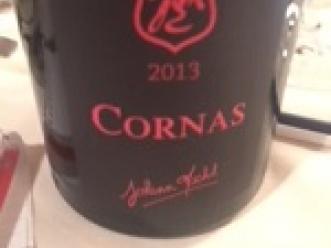
In the less heralded appellation of Cornas, the wines of well-regarded producers such as Auguste Clape are now approaching $100 per bottle.
Is a lover of great French Syrah forced to spend a fortune or to convert to domestic Syrahs?
Happily, some lesser known Rhone Syrah sources have been producing even better wines in recent years. These wines have the classic northern Rhone Syrah characteristics and very much display their unique terroir. At prices well below the more famous stars, they actually offer reasonable value for the money. With the prices of the better California Syrahs steadily creeping up, these lesser known Rhone Syrahs deserve to be better known.
Crozes-Hermitage
Consider Crozes-Hermitage. Long regarded as unqualified to even bear a name related to the famous, nearby Hermitage appellation, the vineyards of Crozes-Hermitage are relatively flat as contrasted to the steep slopes of Hermitage itself. The area of Crozes, on the east side of the Rhone River, is much larger, so the quantity of wine produced is much greater. The broad area encompassed within the appellation is far from homogeneous. Some of the soils are more granitic and some are more clay. It is necessary to seek out specific producers who grow in specific sites.
Our favorite producer in Crozes-Hermitage is Alain Graillot, who is by relative standards a newcomer to the wine business and to the appellation (he started about 1985 after a career as an agricultural machinery salesman). From his rocky, alluvial vineyards in the southern part of the appellation, Graillot’s two red Crozes-Hermitage bottlings, a cuvee Classique and cuvee La Guiraude, are outstanding Syrahs. Graillot is careful to keep his yields low in order to achieve impressively rich wines. They have the spicy, pepper quality sometimes encountered in the best Syrahs that is so enticing, and they display a gamey, almost bloodlike flavor. Both have plenty of tannin and acid. The La Guiraude is slightly more intense. The best news for lovers of classic northern Rhone Syrah are the prices: about $30 for the cuvee Classique and about $75 for the limited-availability La Guiraude.
By the way, lovers of the white wines of the northern Rhone should be aware of Alain Graillot’s blanc, a blend of Marsanne and Roussanne. It is delicately perfumed, well balanced with generous acidity, and utterly delicious. When available (only a small amount is produced), it sells for about $30.
We have been so impressed with the wines of Alain Graillot that we arranged through one of his American importers to pay a visit in 2003 (he is not open to the general public). We arrived at the end of the brutal heat wave that engulfed much of Europe that year. Alain said that the vintage conditions were without precedent, and confessed that neither he nor any other Rhone producer with whom he had consulted had any precise idea of how to handle the harvest. Notwithstanding the challenges of this heat wave, Alain and others throughout the Rhone made very fine wines that year, with a great concentration in the fruit.
St.-Joseph
Another appellation to get to know is St.-Joseph. Like Crozes-Hermitage, this is another relatively large appellation, but on the west side of the Rhone River. St.-Joseph has long been the origin of some rather indifferent wines. And like Crozes-Hermitage, the appellation is far from homogeneous. Many of the vines grow in overly fertile bottomland, whereas a smaller proportion of the vines are on granite hillsides. The diversity of vineyard sites is reflected in the wines, with too large a share producing only simple, undistinguished wines.
Fortunately, some producers are now demonstrating that St.-Joseph can produce some excellent Syrahs. St.-Joseph Syrahs tend to be more forward than other northern Rhone examples, with lower tannin and an appealing fruit character. At their best, they have the spicy and peppery quality that makes northern Rhone Syrah so appealing, and sometimes they have the nuances of meat, bacon, fat and blood that add so much complexity.
Our favorite St.-Joseph comes from Jean-Louis Chave, the same wizard who produces some of the very best Hermitage (and whose family has been doing so for more than 500 years). But J. L. Chave’s “regular” St.-Joseph is a much more affordable $50 per bottle. From his own vineyards, this is as good as St.-Joseph gets. It is clearly a northern Rhone Syrah, with firm tannin, good acidity and those appealing spice, herb, pepper and meaty aromas and flavors. He also offers a St.-Joseph cuvee called Offerus, which sells for about $25. It is from grapes purchased elsewhere within the appellation. While not as concentrated as the regular cuvee, it is still a very tasty Syrah.
Alain Graillot of Crozes-Hermitage has a small hillside vineyard in St.-Joseph too. From its grapes he makes a fine red St.-Joseph, but in very limited quantities. If you can find some, it retails for about $30.
By experimenting with different up-and-coming producers from these lesser known appellations, a wine lover can find reasonably affordable, high-quality northern Rhone Syrahs that display the terroir of the region and have the aromas and flavors of classic Syrah.