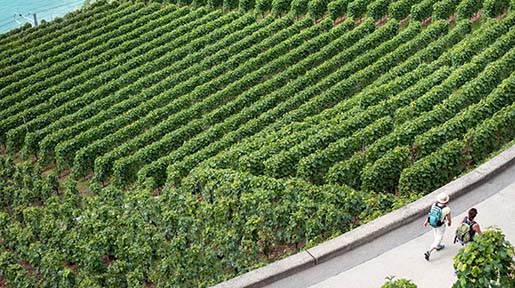
One of the most famous wine regions in the world is Chateauneuf du Pape. Chateauneuf du Pape covers almost 8,000 acres in the southern Rhone Valley of France. The officially demarcated wine region enjoys a very warm climate, baked by the Mediterranean sun. While both red and white wines are made here, it is the red wine that has made this area famous.
Chateauneuf du Pape Recommendations
The name translates as “the new home of the Pope”. In 1308, Pope Clement V was concerned about his, and the papacy’s safety in Rome. He, being comfortable in France as the former Archbishop of Bordeaux, moved the papacy to the Southeastern French town of Avignon. At the time of the move, there was little viticulture in the southern Rhone. A prime growing area turned out to be about 7 miles north of Avignon near the banks of the Rhone River. When Pope John XXII succeeded Clement V, he promoted the wines of the area calling them Vin du Pape which later became Chateauneuf du Pape. It was John XXII who had the Papal castle built in Avignon of which the ruins can be visited today. The reputation of the wines increased over the next few hundred years even after the papacy moved back to Rome. The wines were appreciated for their deep rich colors and the aromatics so much so that wines from Bordeaux and Burgundy are alleged to have added the Chateauneuf wines as an enhancement. The wine region flourished until Phyloxera reached the area in the 1870’s devastating the vineyards, one of the first wine regions in France to be afflicted.
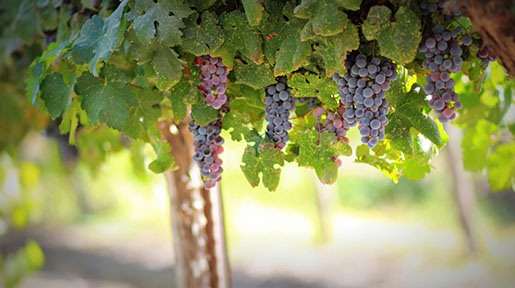
By the early 20th century, the wine industry had recovered and flourished. Regrettably, much wine was being sold as Chateauneuf du Pape wasn’t actually from the region. Often times it was from nearby growing areas of lesser quality. In response to this wine fraud, the Appellation Contrôlée (AOC) was created to administer and govern over the wine production and marketing in France. Chateauneuf du Pape was its first region with defined rules that covered viticultural practices. The initial AOC rules allowed the use of ten different grape varietals. In 1936 the number was increased to these thirteen: Grenache, Syrah, Mourvèdre, Cinsault, Muscardin, Cournoise, Clairette, Bourboulenc, Picpoul, Roussanne, Terret Noir, Picardan, Vaccarese. Grenache, comes in both red and white, usually referred to as Grenache blanc so some would say there are 14 permitted types of grapes. These grapes are both red and white and there is no mandated proportion in which they must be used. Grenache is the most prolific grape used followed by Syrah and Mourtvedre. The remaining grapes are used in small proportions. Most wineries use but a fraction of the allowable grapes. In addition, the AOC laws regulate minimum alcohol levels and limits on vineyard productions levels known as yields. As an amusing note, in 1954 a ban was enacted prohibiting flying saucers from flying over the vineyards and even taking off and landing.
By the 1970’s Chateauneuf du Pape had lost favor with the wine buying public. The wines were quite rustic and the wineries often not kept very clean. There were still a steady stream of buyers, especially for the better wines, but the international marketplace had left Chateauneuf behind. Fortunately, wine critic Robert Parker championed these wines as some of the best quality for the price ratio wines available. Parker’s influence on the buying public is immense and soon the world rediscovered these wines.
The most important part of the terroir seems to be its soils. In the north, the soil is filled with galets which are small round rocks and pebbles mixed in and covering the clay soil. These smooth round rocks are remnants of the days glaciers covered the area. They capture the heat of the day and keep the vines warm at night helping the grapes to ripen more quickly. In addition, the stones help the soils retain moisture during hot dry summers. Not all the vineyards contain this kind of soil, as the rest of Chateauneuf has either sandy or coarse soils. The better of these vineyards are the more traditional southern facing exposures. In addition to the unique earth, the famous Mistral winds blow hard and keep the vineyards free from rot.
Chateauneuf du Pape can be made as either a red or white wine although the red is by far the most common. As French wines go, Chateauneuf du Pape has more alcohol than most, usually in the 13% to 15% range, which is far less than most new world wines. The wines can be drunk young, within the first few years of vintage. At that time they have a strong fruit profile with nice acidity. Then the wines tend to shut down or hibernate. No one knows why wines do this, but it is common in many French wines. From a few years and into the next decade, the wines show very little and seem almost muted. Finally, they emerge like a butterfly from a cocoon as mature, layered complex wines. They still have some fruit but the leather, earthiness and floral tones are more pronounced. This is true for both the red and white wines.
Chateauneuf du Pape red wines are usually ruby in color. Those with higher percentages of Syrah may be a bit darker and more purple. They have great cherry and raspberry fruit but it is the presence of barnyard, spice and lavender aromas that make it distinctive. The spice is often called garrique which is the French word for the dried herbs common in the area that grow wild across Chateauneuf du Pape.
The white is made utilizing six of the thirteen permitted varietals that are white. Depending who you rely on for production figures, the white wines amount to about 5% of all the Chateauneuf du Pape produced. These wines are mineral driven with honeysuckle and peach flavors. They are wines that should be consumed young as they become quite fickle when aged. Some age well although it is often hard to tell when they have reached a mature point to open.
Chateauneuf is a traditional winemaking area. Most wines are vinified either in large cement tanks or large wood barrels, much larger than typical oak barrels. The Grenache grape is prone to oxidation and small French oak barriques now in vogue in so many areas are often thought not to work well.
One growing trend is for the wineries to make luxury cuvees in addition to their regular bottling. This means the wineries are taking some of their better batches of wine and releasing them as a separate bottling. In some cases this could be better vineyards or locations within a vineyard. In other wineries, this could be the better barrels being held aside before bottling. These luxury cuvees are given a unique name and often cost in excess of $100 a bottle.
Chateauneuf du Pape has been blessed by a series of excellent and very good vintages. 1998 and 2001 were my favorites in the last 10 years. However, the only poor vintage in the last decade has been 2002 as torrential rains and hail at harvest had a deleterious effect on the vintage. The soon to be released 2007’s have the wine cognoscenti drooling. Robert Parker called it the best vintage of Chateauneuf du Pape in his lifetime.
So what wineries should you look for? There are a lot of good choices. Perhaps my favorite is Chateau de Beaucastel. The Perrin family has run this estate since 1909. The estate itself can trace its roots back to the mid-1600’s. Their Chateauneuf du Pape is a bit different as the primary grape is Mourvèdre. Beaucastel however, is one of the few wineries that grow all thirteen permitted varietals. These are massive wines that can be drunk immediately on release but they tend to shut down after a year or so, only to reemerge after about seven years as a complex layered wine. The 1989 is one of the best wines I have ever had and is still drinking quite well. The cost on this well reviewed wine has risen in recent years and a bottle can cost around $90. They make a luxury bottling called Hommage a Jaques Perrin (the Perrin family owns and operates this estate). The Hommage now costs nearly $400 a bottle. They also make a less expensive wine under the Cotes du Rhone appellation. Not technically a Chateauneuf du Pape, their Coudoulet de Beaucastel drinks like a Chateauneuf du Pape and can be aged for 5 to 10 years. It can be found for around $30. I tend to buy both the Coudoulet and the regular Chateauneuf du Pape for my cellar.
Clos des Papes is another winery I tend to buy every year. It is run by the father and son team of Paul and Vincent Avril. Their wines have traditionally been good, but with the 2000 vintage there has been a seriously jump up in quality. The Avrils were rewarded for all their hard work when their 2005 vintage was named the Wine Spectator magazine’s Wine of the Year. With the recognition came higher prices. This wine used to be available for close to $50, is now selling for over $100 a bottle. Often the spectacular 2001 Clos des Papes can be found for less and is closer to being fully mature. Although I buy less of this wine in each new vintage than I used to, a bottle or two is still on my list. Clos des Papes makes no luxury cuvee. The Avrils do make a value wine under their own name and not labeled as Chateauneuf du Pape.
Domaine du Pegau is another winery in Chateauneuf du Pape that I try to buy every year, although the price escalation has hit here too. The Fèraud family has been farming this area since the 17th Century. In the 1960’s they began to bottle a bit of wine on their own. In 1987, Domaine du Pegau was created to be run by the father-daughter team of Paul and Laurence Fèraud. Today, the daughter, Laurence runs the estate. The word Pegau comes from the name of the jugs used to hold wine in the 13th century in the papal palace at Avignon. The basic Chateauneuf du Pape, called the Cuvee Reserve, is for me the one to buy. The price has risen to about $80 a bottle, but this is fantastic wine that needs 10 to 15 years to really hit its peak. They make Cuvee Laurence which is similar to the Reservee but sees more time in oak. It costs a bit more and I don’t think it is worth the extra money. At the luxury cuvee level, Pegau’s Cuvee de Capo is just a spectacular wine. So is the price, routinely selling for over $500 a bottle.
There are too many wineries making great Chateauneuf du Papes to list them all. Some of my other favorites include the more reasonably priced luxury cuvees Domaine Grand Veneur Les Origines, Domaine Pierre Usseglio Mon Auiel, and Cuvee de Vatican Reserve Sixteen. I also like the regular Chateauneuf du Pape’s from Domaine Charvin, Vieux Telegraphe, Pierre Usseglio, and Chateau Le Nerthe. I should mention the Guigal winery. This is the mega winery in the Rhone region. They make a very nice Chateauneuf du Pape. A few years ago, the Wine Spectator magazine also named this as their wine of the year. One of the reasons the magazine chose it as their wine of the year, was because it was a very good wine that was priced so inexpensively. It was not necessarily a great wine but it was a great wine value. Overnight, due to the publicity, the retail price of the wine doubled from $20 a bottle to $40. Personally, I quit buying it at that higher price as it was no longer a great value. The price has again come down and the wine is now selling for closer to $30. As other Chateauneuf du Papes have raised their price, Guigals version is now returning to the point where it is a good value. It is not a great wine, but it is a solid, correct and tasty wine that for the right price is worth buying.
One caveat for purchasing wines in the near future would be to remember that the wine market is not immune to the current worldwide economic slowdown. There is a lot of Chateauneuf du Pape wine in the sales pipeline. The string of good to great vintages has created a bit of a stockpile on retailer and distributor shelves. With the fantastic 2007’s about to hit the market, I would look for plenty of sales and good values in the next few months.
I have for the most part ignored the issue of white wines. Many of the wineries listed make a white Chateauneuf du Pape. These can be interesting wines and even excellent. They can be expensive and are not for everyone. If you are feeling adventurous, by all means, try one. The better red producers are also the better white producers.
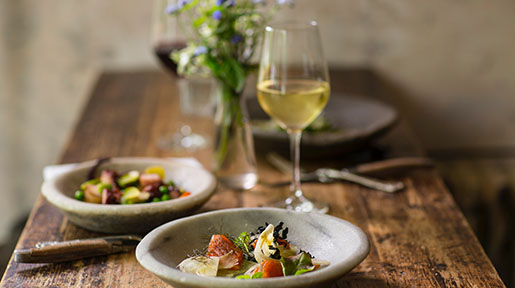
Chateauneuf du Pape’s are great food wines. Younger vintages go well with a main course. The natural matches are beef or lamb, especially stews. They are quite versatile and go great with pastas as well. Once mature, they are excellent with a cheese course at the end of a meal.
One last note about Chateauneuf du Pape. The bottles themselves are quite interesting. Most have a custom made seal with either the seal of the particular winery or some sort of Papal insignia inlayed on the bottle itself. Many use the Papal coat of arms while others use their family’s emblem.
These are some of the finest wines in the world. I hope you all go out and try a bottle. Please let me know what you think.
Loren Sonkin is an IntoWine.com Featured Contributor and the Founder/Winemaker at Sonkin Cellars.