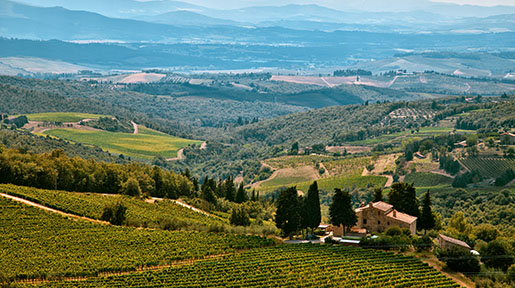
About 110 miles southeast of Paris, at the northern tip of the Burgundy wine region France lays Chablis. Chablis is the name of a village that has given its name to a region producing some of the best white wines in the world. The region of Chablis encompasses 19 towns and is about twenty by fifteen kilometers in size. In France, by law, wines are named after the place where they are fashioned and not the grape varietal. The wine producers of Chablis have spent hundreds of years determining which grapes produce the best wines for their soils and the answer: crisp, mineral-driven wines made from the Chardonnay grape.
It was the Romans who first started planting vines in the area. By the Dark ages, the wines were being cultivated by the local monasteries. As early as 865AD the monks of Saint-Martin-de-Tours were making Chablis on the slopes of the Serein River which dissects the town. The wines were being sold in the town of Auxerre and destined for the markets of Paris. Records dating back to the mid-1400’s show Chablis wines being shipped to England and Belgium. Unfortunately, the town of Chablis was destroyed in 1568 by the Huguenots. Before the wine industry could recover, the town endured the French Revolution and invasions from Prussia. As the vineyards began to recover, Phyloxera found its way there destroying them. After replanting, production of wine increased to 160,000 cases in the 1930’s. Of course, World War II took its toll, but the vineyards soon recovered. By the 1970’s and 1980’s there was a worldwide boom and the demand for Chablis soared.
Most people agree that what makes Chablis special is what the French call terroir. The soils are famous for Kimmeridgian clay and chalk. Millions of years ago this area was an ocean floor and the area has many sea fossils. Over the eons, this developed in a mineral rich soil which makes for distinctive chardonnays. Perhaps that is the reason many people believe good crisp Chablis and oysters to be a magical food and wine pairing.
The climate and characteristics of Chablis more closely resemble the region of Champagne which is only thirty miles away than the center of Burgundy, the village of Beaune, that lies 100 miles to the south. Despite the success of wine makers here, however, this is a difficult region to make wine. It is one of the most northern regions that successfully make table wines. The summer days are long but temperature can be an issue. There is a constant exposure to frost for the vines. There have been many years where the entire crop has been destroyed. People still talk about the late frosts of 1957 and 1961 which left many vineyards destroyed. Modern (and less modern) techniques of windmills, sprinklers and heaters have helped the growers in more recent years.
In 1938, the Appellation d'Origine Contrôlée (AOC), the governmental agency in charge of vineyard classification and other wine related issues, released the primary classification of Chablis vineyards. Petit Chablis vineyards (theoretically lesser quality vineyards), was classified in 1944. Regrettably, with the boom of the 70’s and 80’s the governmental agency in charge of classifying vineyards relaxed its rules and allowed some of the previously abandoned vineyards to be labeled as Chablis. In addition, some land was promoted (unjustifiably?) to a higher classification.
The classification divides the vineyards into a four level hierarchy of the vineyards. At the lowest level is Petit Chablis. These vineyards tend to be at the top of the hills or at the bottom in the valleys. There are some very nice inexpensive Petit Chablis from these areas though. The vineyards are usually on limestone soils and not the Kimmeridgian clay and not the best sites. The wines are not meant to be aged and should be drunk within the first few years.
The next steps up are the wines labeled simply as Chablis. These tend to be from south facing areas low down on the hillsides or middle hillside vineyards in less favorable spots. Some are on the famous Kimmeridgian chalky soils. These wines are more interesting and show some of the classic Chablis profiles. There are approximately 11,000 acres under vine for this area.
At the next level up are the Premier Cru vineyards with about 1900 acres distributed among 40 vineyards. These are located on either side of the Serein River and most face either southwest or southeast. Some of the best quality-to-price wines are found in this classification. Although not inexpensive, these wines have wonderful concentrated mineral and fruit qualities. The wines are meant to age and while they can be delicious young, they are best at five to ten years from vintage. Some of the more famous vineyard sites include: Les Fourchaumes, La Montèe de Tonnerre, Le Mont de Milieu, Les Montmains, and Les Vaillons. These wines normally reach their peak from 5 to 10 years old.
Finally, the highest levels of classification are the Grand Cru vineyards. There are approximately 250 acres of Grand Cru vineyards covering 7 different vineyards. They are Les Blanchots, Les Bouguerots, Les Clos, Les Grenouilles, Les Preuses, Les Valmur and Les Vaudèsir. These are, to my mind, the best expression of wines made from the Chardonnay grape created anywhere in the world. The wines are large and full bodied with exuberant fruit. Despite their structure and size, they have wonderful acidity that delivers with pinpoint precision. They can be drunk young (although I would recommend decanting) yet can age effortlessly for ten to twenty years, even longer in the best vintages.
Good Chablis should be lightly golden in color. With age the gold color deepens. The wine should have fruit scents of green apples with some lemon and/or lime quality to it. At the same time, there is a mineral quality that is often described as flinty. Others might attribute a crushed rock type of quality. When drinking, the most distinguishing feature to me is the acidity. These are sharp wines that go well with food. While sea food is the typical fare, the acidity allows these wines to be a great match with even pastas or stews and certainly fowl, if that is your preference. Good Chablis has flavors to match the aromas with perhaps a bit of vanilla from certain producers that use oak barrels. Most producers, however, choose to vinify their wines in stainless steel which takes advantage of the natural crispness found in these wines.
Whenever choosing a wine to try, producer and vintage do matter. There are wines on the shelves labeled as Chablis that are not worth your money. In my opinion there are two top producers in Chablis. The first would be Domaine Raveneau. Run by two brothers, Bernard and Jean Marie, they make some of the best Chablis and hence, some of the best white wines in the entire world. The Domaine, started by their father, has been producing wines since 1948. In the 1970’s the wines began being imported into the USA by Kermit Lynch and slowly their reputation grew. They make a variety of different Chablis including both Premier and Grand Cru. The wines can be austere and are very traditional. They will vary from vintage to vintage as the brothers take what nature has to offer rather than forging a house style. With fame, however, has come high prices. The Premier Cru wines now cost between $100 and $300 dollars depending on the vineyard, with the Grand Cru wines topping $400 for a bottle.
A little less expensive, but catching up fast, is Domaine R&V Dauvissat (not to be confused with Jean Dauvissat). Started in 1931 by Renè Dauvissat and now run by Vincent Dauvissat, they make wonderful Chablis. Vincent farms the entire 23 acres by himself. I hesitate to call them modern (as a comparison to Raveneau) as that would be wrong, but this is one Domaine that does age their wine in oak barrels. They use a smaller oak barrel than typical in the rest of Burgundy. Yet, their use of oak is judicious and allows their wines to be a bit rounder. The Grand Cru wines receive only 20% new oak and the Premier Cru wines see between 3 and 15% new oak. The cost of Dauvissat wines begin at $26 for their Petit Chablis and can increase to $200 a bottle for their Grand Crus.
While both Raveneau and Dauvissat should not be missed Domaine William Fevre is a third producer who has really ratcheted up quality and is a contender for the title of some of the best wines to come from Chablis. William Fevre founded Domaine de la Maladière in 1959. In 1998, the Henriot family of Champagne bought the winery and began producing wines under the William Fevre name. These wines are much more affordable, starting at $20 and going up to the mid $100’s for their Grand Crus. This is the Domaine getting the bulk of my Chablis dollars these days.
There are other good producers of Chablis. I have enjoyed the wines from Billaud-Simon, Bouchard, Droin, Jean Marc Broacard, and Verget. I am sure there are many other very good producers too. As for vintages, 2004, 2002, 1996, and 1992 were outstanding in my opinion. 2005, 2001, 1999 and 1995 were very good. I would not shy away from the 2000’s either. I did not like the over blown 2003’s, however, which were affected by the intense heat of that summer. I have heard good things about the 2006 vintage but have not had enough to render an opinion.
As far back as the 1800’s, many wineries tried to take advantage of the high reputation of Chablis when nearby communities would label their wines as Chablis. This is no longer permitted under French and European law but the rules for labeling wines by the name of the region do not apply outside of Europe. Many wine producers around the world seek to take advantage of the name Chablis, and have adopted this moniker for white wines that may not even be made with Chardonnay grapes. One can find Chablis-labeled wines produced in New York, California and Australia. These tend to be sweet, massed produced wines and are in no way related to the glorious wines of the region of Chablis.
I hope you all go out and try a bottle of the real Chablis. Please, let me know what you think.
Loren Sonkin is an IntoWine.com Featured Contributor and the Founder/Winemaker at Sonkin Cellars.